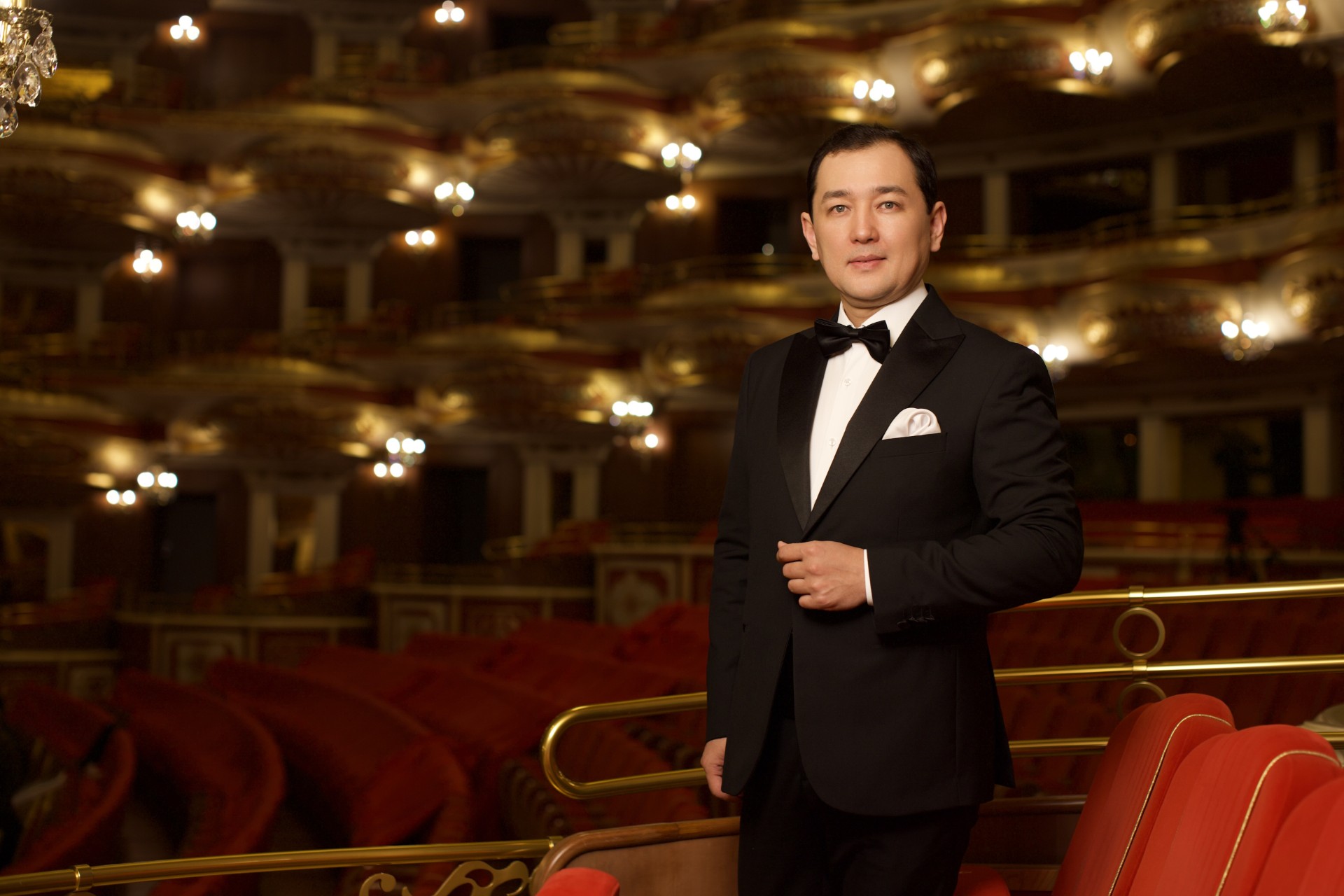

In 2026, the Honoured Worker of Kazakhstan, opera company director of the Astana Opera, renowned baritone Talgat Mussabayev celebrates 25 years on the opera stage. This quarter-century milestone is marked by brilliant interpretations of major roles, critical acclaim, and appreciative audiences. Reflecting on this landmark anniversary, the master of the stage arts shares his insights and looks to the future.
As the torchbearer of the famous Mussabayev dynasty, whose name resonates across the country, he views his surname as a high standard set by his father, Marat, and his uncles, Rashid and Murat. Critics routinely praise his artistry in the highest terms: Professor Umitzhan Dzhumakova highlights his ‘sumptuous voice’, musicologist Zhanat Ordaliyeva notes his ‘harmonious character portrayals’, and critic Mikhail Krivitsky (Muzykalnaya Zhizn) commends his ‘deeply meaningful monologues’. In conversation, Talgat Mussabayev is thoughtful, demanding of himself, and profoundly committed to his craft.
- Talgat, how do you feel as you approach this 25-year milestone on the stage?
- You know, those 25 years flew by in an instant. At first, you count the years: the first season, the second, the fifth... But later, when you are busy and in high demand, you stop noticing the passage of time. You barely close one season before you are looking forward to a holiday, just to recharge your batteries and plunge straight back into the endless sea of operatic art. I truly established myself as an opera singer and performer thanks to a tremendous amount of hard work and collaboration with the incredible people – musicians, teachers, and conductors – I have met along my professional journey. Working alongside such outstanding personalities helps you grow, allowing you to find your own individuality and unique flair. Today, I have over twenty title roles in my repertoire. There are the heavy, robust ones like Abai, Rigoletto, Amonasro, and Rodrigo, among others, and then there is a very special one: Onegin. That was the production that opened the doors to the grand stage for me; it was the starting point of my artistic journey. Unlike many singers, I never had a dream to perform one specific character. I have always been drawn to everything new, and I prefer to work on pieces that truly resonate with my heart. No two roles are alike; you find new colours and facets in every single one. Ultimately, tackling any role requires deep research and a profound understanding of the character you are interpreting. Take the role of Abai, for instance. It is the most vibrant and defining baritone role in the Kazakh opera repertoire, and I absolutely love performing this complex character. For me, as for all Kazakhs, Abai is a monumental figure. I believe that everything good and just in humanity is reflected in his character. Portraying him is a challenge because the performer carries a tremendous responsibility to feel and convey the sheer depth and scale of this great thinker and genius’ worldview. Musically speaking, it is equally demanding, as the part is written for a powerful baritone voice. To do it justice, the dramatic narrative must blend harmoniously with the musical score. As you mature, you realise there is no limit to perfection. Every time you step onto the stage, you find fresh, interesting interpretations, reading between the lines in a new way and discovering deeper meanings for yourself.
- What were the major milestones along your artistic journey?
- First comes the formative stage: you arrive at the opera house and absorb everything like a sponge, building up your skills and potential. Next, you establish a professional benchmark for yourself – a standard that you can never allow to slip, only build upon. In my case, as a singer from a long-established musical family, the bar was set incredibly high from the very start. When I entered the world of opera, I already carried a reputable family name. The hardest part was living up to it.
- Did that put pressure on you?
- No, I was born into it and grew up with it. In the early days, of course, I was compared to my established relatives. That is precisely why I did not rush; I took my time. I didn’t enter competitions, and I didn’t attempt to debut new roles prematurely until I was absolutely ready. It is far better to do the job properly first, and only then present it to the audience, giving them no reason to doubt your professionalism. Right now, as a baritone, I am at my peak. The ages between 40 and 50 represent a singer’s physical maturity – a period of refined technique and a musical taste shaped by experience and practice. Now, you can give so much more of yourself to the audience artistically and emotionally. That is why I always tell young singers that the most important thing is to choose your repertoire wisely and chart a clear trajectory for your development for years to come.
- Has the role of the opera singer changed over the past 25 years?
- Certainly. First came the era of the singer, which transitioned into the era of the conductor, and today we find ourselves in the era of the stage director – an approach that brings its own unique complexities. At times, the visual spectacle can take precedence, meaning the music and vocal lines naturally move a little more into the background. A soloist can occasionally feel like just one component within a massive production, rather than a distinctive individual, even though I believe the voice is the primary instrument of opera. A true Artist is meant to lead the performance and hold the audience spellbound from beginning to end. Within the framework of contemporary stage director-led opera house, it is vital that we maintain that essential truth: the artist’s self-expression through the unique power of the voice.
- A year ago, you were appointed opera company director of the Astana Opera. Which is easier: performing the role of Rigoletto or managing the opera company?
- Singing, without a doubt (smiles). When I perform a role on stage, I am only responsible for my own work. As for the premiere of Rigoletto at our opera house, this title role has long been a part of my repertoire, and each time I revisit it, it reveals a different side of myself. For me, Rigoletto is not just a caricature; I view him as a man desperately fighting for his daughter and for the right to be heard. There is pain in his every word and truth in his every gesture. Administrative work is an entirely different challenge. The difficulty lies in managing a team of forty soloists – all strong personalities, each with their own unique vision and needs. You have to find a unified direction for the company’s development, cultivate musical sensibilities in the younger soloists, support them, and maintain constant contact. It demands an enormous amount of physical and emotional energy. And of course, as the opera company director, you bear the ultimate responsibility for the final product – for ensuring that thousands of audience members leave the auditorium feeling emotionally enriched.
- Is it possible to make opera relatable to the younger generation?
- That is our primary objective. The world has changed, the pace of life has quickened, and young people are constantly exposed to popular music that isn’t always of the highest quality. Some even view the classics as a bit old-fashioned. Our mission, therefore, is one of advocacy: to convey the true value of opera through vibrant, accessible productions and impeccable performances. We need to start small, with children’s operas, comic pieces, and light, engaging music, because monumental opera can be difficult to grasp right away. We are already seeing a growing, younger audience at the Astana Opera, which is incredibly encouraging. On the whole, opera in Kazakhstan is still a young genre – only 90 years old – and for Astana and our opera house, this is a history that is only just beginning to be written.
- Your voice is an instrument, but what serves as its fuel?
- In your youth, it is probably raw energy, physical stamina, and a healthy sense of ambition. Over the years, however, everything is sustained by an unbridled love for the craft, devotion to high art, refined technique, and emotional fulfilment. The most important thing for a singer is to maintain peak vocal fitness, ensuring the voice always remains fresh and rich in tone. A baritone with solid training can sing until he is 70 or older. Sometimes, I simply need to sit in total silence to recharge, filling myself with energy so I can give it all back on stage. Ultimately, the most essential fuel is loving what you do. If your work is your passion and you find joy in it, that is pure happiness. You are no longer working; you are living it.
- What are you like at home with your family? How do you switch off from the world of opera?
- You know, I have very little time for myself and my family right now, between the opera house and teaching at the university. At times, I feel guilty that I don’t give my children enough attention. But my home is my sanctuary. I am a family man at heart, and my way of unwinding is simply being at home with them. They are my rock and my very first critics. Everything I do is meant to be a living example for them, so that my children see what hard work looks like, value our culture, and understand true dedication to a craft. For me, family is the foundation that gives me the strength to do everything else.